Advanced Tutorial
Modifying the BaseAgent
To demonstrate the direct method, let’s build a new human agent from scratch. We’ll start with the simples version: a human that consumes oxygen every step. In order to build this using the Direct method, we will:
Initialize an empty AgentModel
Add a currency,
o2Create a
habitatagent which has capacity for 1000 o2, and has 1000 o2 in storageCreate a
humanagent which has an in-flow of 1 o2 per step from the habitatAdd these agents to the model
Run the model for 100 steps
Plot the habitat storage and human flows
[1]:
# Ignore this
import sys
sys.path.append('../../src')

from simoc_abm.agent_model import AgentModel
from simoc_abm.agents import BaseAgent
from simoc_abm.viz import plot_agent
import matplotlib.pyplot as plt

# Helper function to run model and plot records
def run_and_plot(model):
    for i in range(100):
        model.step()
    records = model.get_records()
    fig, axs = plt.subplots(1, 2, figsize=(12, 3))
    plot_agent(records, 'habitat', 'storage', ax=axs[0]);
    plot_agent(records, 'human', 'flows', ax=axs[1]);
    return records

# Initialize Model with 'o2' currency
model = AgentModel()
model.add_currency('o2')

# Initialize Agents
habitat = BaseAgent(model, 'habitat', capacity={'o2': 1000}, storage={'o2': 1000})
human = BaseAgent(model, 'human', flows={'in': {'o2': {'value': 1, 'connections': ['habitat']}}})

# Add agents to the model
model.add_agent('habitat', habitat)
model.add_agent('human', human)

records = run_and_plot(model)

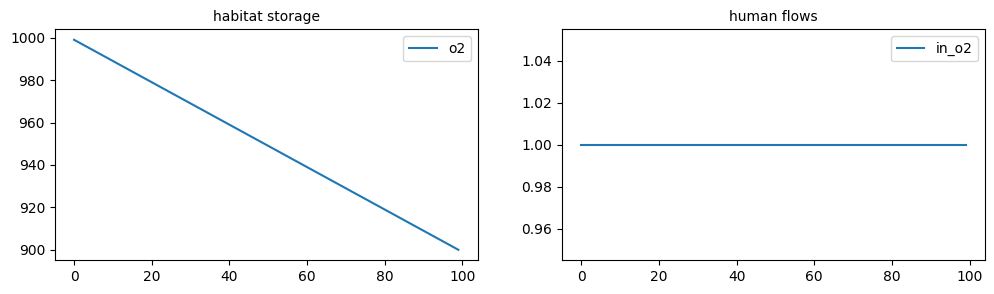
The habitat storage line is uneven. This is because, without a priorities argument and defined classes, agents step in a random order. Records are saved at the end of each agent’s step, so if the habitat steps before the human on some step, the human’s flow won’t be taken into account. We can fix this by adding a class to each agent, and adding a ‘priorities’ argument to our AgentModel.
[2]:
model = AgentModel(priorities=['inhabitants', 'structures'])
model.add_currency('o2')
habitat = BaseAgent(model,
                    'habitat',
                    agent_class='structures',
                    capacity={'o2': 1000},
                    storage={'o2': 1000})
human = BaseAgent(model,
                  'human',
                  agent_class='inhabitants',
                  flows={'in': {'o2': {'value': 1, 'connections': ['habitat']}}})
model.add_agent('habitat', habitat)
model.add_agent('human', human)
records = run_and_plot(model)
Of course humans also exhale carbon dioxide, and it should be proportional to the oxygen they inhale. Let’s add this with a new currency, co2. We’ll need to: 1. Add another currency 2. Add capacity for that currency in our habitat 3. Add an out-flow of co2 to our human 4. Make this outflow proportional to the inflow of co2 using the ‘requires’ field.
To make sure we’ve done (4.) correctly, let’s initialize our habitat with less than enough o2.
[3]:
model = AgentModel(priorities=['inhabitants', 'structures'])
model.add_currency('o2')
model.add_currency('co2')
habitat = BaseAgent(model,
                    'habitat',
                    agent_class='structures',
                    capacity={'o2': 1000, 'co2': 1000},
                    storage={'o2': 80})
human = BaseAgent(model,
                  'human',
                  agent_class='inhabitants',
                  flows={'in': {'o2': {'value': 1,
                                       'connections': ['habitat']}},
                         'out': {'co2': {'value': 1,
                                         'connections': ['habitat'],
                                         'requires': ['o2']}}})
model.add_agent('habitat', habitat)
model.add_agent('human', human)
records = run_and_plot(model)

Humans die if they don’t get enough oxygen. This usually happens after a couple minutes, but for demonstration purposes let’s say this happens after 5 steps (hours):
Add a
depriveparameter to the o2 flow such that the agent will die if it doesn’t get the target amount for 5 consecutive steps.Deprive uses an
attributeto track the time left, so let’s create a new helper function to also plot the human attributes.
[4]:
def run_and_plot(model):
    for i in range(100):
        model.step()
    records = model.get_records()
    fig, axs = plt.subplots(1, 3, figsize=(12, 3))
    plot_agent(records, 'habitat', 'storage', ax=axs[0]);
    plot_agent(records, 'human', 'flows', ax=axs[1]);
    plot_agent(records, 'human', 'attributes', ax=axs[2]);
    return records

model = AgentModel(priorities=['inhabitants', 'structures'])
model.add_currency('o2')
model.add_currency('co2')
habitat = BaseAgent(model,
                    'habitat',
                    agent_class='structures',
                    capacity={'o2': 1000, 'co2': 1000},
                    storage={'o2': 80})
human = BaseAgent(model,
                  'human',
                  agent_class='inhabitants',
                  flows={'in': {'o2': {'value': 1,
                                       'connections': ['habitat'],
                                       'deprive': {'value': 5}}},
                         'out': {'co2': {'value': 1,
                                         'connections': ['habitat'],
                                         'requires': ['o2']}}})
model.add_agent('habitat', habitat)
model.add_agent('human', human)
records = run_and_plot(model)
print(model.agents['human'].cause_of_death)
human deprived of o2

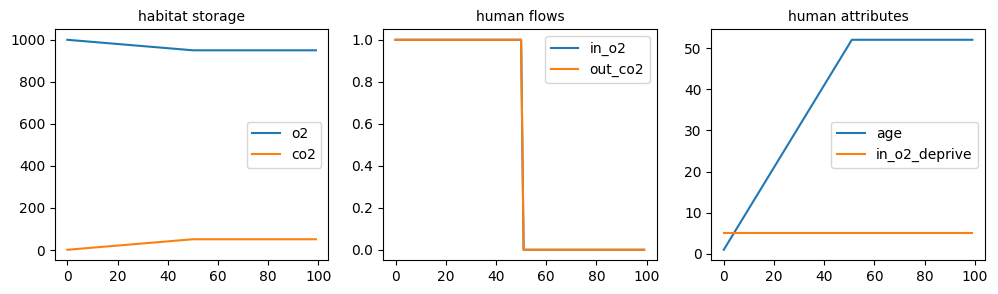
Humans can also die if the CO2 levels get too high. We can model this as a ‘threshold’: when the co2 ratio gets above a certain level (for demonstration purposes let’s say 5%), they die. We’ll set the o2 level back to 1000 and expect our humans to die of excess co2 after ~50 steps.
Add a
thresholdfield to the agent using the pathout_co2_ratio, which will check the out-bound co2 connection, and evaluate the level of co2 compared to other currencies of the same category.We also need to add a
categoryargument to o2 and co2 currencies, so it knows the basis of comparison. Let’s call thematmosphere.
[5]:
model = AgentModel(priorities=['inhabitants', 'structures'])
model.add_currency('o2', category='atmosphere')
model.add_currency('co2', category='atmosphere')
habitat = BaseAgent(model,
                    'habitat',
                    agent_class='structures',
                    capacity={'o2': 1000, 'co2': 1000},
                    storage={'o2': 1000})
human = BaseAgent(model,
                  'human',
                  agent_class='inhabitants',
                  thresholds={'co2': {'path': 'out_co2_ratio',
                                      'limit': '>',
                                      'value': 0.05}},
                  flows={'in': {'o2': {'value': 1,
                                       'connections': ['habitat'],
                                       'deprive': {'value': 5}}},
                         'out': {'co2': {'value': 1,
                                         'connections': ['habitat'],
                                         'requires': ['o2']}}})
model.add_agent('habitat', habitat)
model.add_agent('human', human)
records = run_and_plot(model)
print(model.agents['human'].cause_of_death)
human passed co2 threshold
The amount of air a human breathes is basically proportional to their weight. To account for this, we can scale the value of each flow to the humans’ weight.
Add a new
propertyto humans called “mass”.Add a
weightedparameter to the human flows with “mass” (this is “weight” as in “multiplier for a number”, not “mass” - just a coincidence).If we assume the average mass of a human is 80kg, we should divide the value by 80, so that the value is correct after applying the weight.
If we give our human a mass of 70kg and leave everything else the same, we’d expect them to live a bit longer.
[6]:
model = AgentModel(priorities=['inhabitants', 'structures'])
model.add_currency('o2', category='atmosphere')
model.add_currency('co2', category='atmosphere')
habitat = BaseAgent(model,
                    'habitat',
                    agent_class='structures',
                    capacity={'o2': 1000, 'co2': 1000},
                    storage={'o2': 1000})
human = BaseAgent(model,
                  'human',
                  agent_class='inhabitants',
                  thresholds={'co2': {'path': 'out_co2_ratio',
                                      'limit': '>',
                                      'value': 0.05}},
                  properties={'mass': {'value': 70}},
                  flows={'in': {'o2': {'value': 1/80,
                                       'connections': ['habitat'],
                                       'deprive': {'value': 5},
                                       'weighted': ['mass']}},
                         'out': {'co2': {'value': 1/80,
                                         'connections': ['habitat'],
                                         'requires': ['o2'],
                                         'weighted': ['mass']}}})
model.add_agent('habitat', habitat)
model.add_agent('human', human)
records = run_and_plot(model)
print(model.agents['human'].cause_of_death)
human passed co2 threshold

Next, we’d expect our humans to breath less at night. An easy way to do this is by adding a growth parameter to our flows. There are several types of growth supported, but “switch” is the simples - it just flips back-and-forth between the min_value (default 0) and max_value (default 1) on a daily basis, and these are applied to the flow value as weights.
The “switch” growth function also includes a center and duration parameters, both of which are 0.5. Center is the point within a day (0-1) at which the active period is centered, and duration is the fraction of the day which is active.
Add the
growthparameter to o2 and co2 flows, of type “switch”.We don’t want o2 consumption to be 0 at night, otherwise they’ll die (from o2 deprivation). Instead we can specify a
min_valueof 0.5.Set
centeranddurationto mimic a typical sleeping schedule of 10pm-6am: we’ll move the center forward 2 hours, and increase the duration to 16 hours.
[7]:
model = AgentModel(priorities=['inhabitants', 'structures'])
model.add_currency('o2', category='atmosphere')
model.add_currency('co2', category='atmosphere')
habitat = BaseAgent(model,
                    'habitat',
                    agent_class='structures',
                    capacity={'o2': 1000, 'co2': 1000},
                    storage={'o2': 1000})
human = BaseAgent(model,
                  'human',
                  agent_class='inhabitants',
                  thresholds={'co2': {'path': 'out_co2_ratio',
                                      'limit': '>',
                                      'value': 0.05}},
                  properties={'mass': {'value': 70}},
                  flows={'in': {'o2': {'value': 1/80,
                                       'connections': ['habitat'],
                                       'deprive': {'value': 5},
                                       'weighted': ['mass'],
                                       'growth': {'daily': {
                                           "type": "switch",
                                           "min_value": 0.5,
                                           "center": 14/24,
                                           "duration": 16/24}}}},
                         'out': {'co2': {'value': 1/80,
                                         'connections': ['habitat'],
                                         'requires': ['o2'],
                                         'weighted': ['mass'],
                                         'growth': {'daily': {
                                             "type": "switch",
                                             "min_value": 0.5,
                                             "center": 14/24,
                                             "duration": 16/24}}}}})
model.add_agent('habitat', habitat)
model.add_agent('human', human)
records = run_and_plot(model)
print(model.agents['human'].cause_of_death)
human passed co2 threshold

Custom Agent Classes
We can customize things even further by creating subclasses of our BaseAgent. To demonstrate this, we’ll build a new agent, ‘tree’, to recycle the air in our habitat to keep the human alive.
The tree will have
storageandcapacityfor its internal biomassIt will have
flowsof o2 and co2, but some of the co2 will be converted to internal biomass.We’ll make the flows
weightedby the current level of internal biomass, to reflect the fact that bigger plants produce/consume more.We’ll add
growthof type ‘normal’ to reflect the levels of sunlight throughout the day.
We’ll setup a new helper function to return our current setup and save space, and update the run_and_plot helper function to plot our tree as well.
[8]:
def get_human_model():
    model = AgentModel(priorities=['inhabitants', 'structures'])
    model.add_currency('o2', category='atmosphere')
    model.add_currency('co2', category='atmosphere')
    habitat = BaseAgent(model, 'habitat', agent_class='structures', capacity={'o2': 1000, 'co2': 1000}, storage={'o2': 1000})
    human = BaseAgent(model, 'human', agent_class='inhabitants', thresholds={'co2': {'path': 'out_co2_ratio', 'limit': '>', 'value': 0.05}}, properties={'mass': {'value': 70}},
                      flows={'in': {'o2': {'value': 1/80, 'connections': ['habitat'], 'deprive': {'value': 5}, 'weighted': ['mass'], 'growth': {'daily': { "type": "switch", "min_value": 0.5, "center": 14/24, "duration": 16/24}}}}, 'out': {'co2': {'value': 1/80,'connections': ['habitat'], 'requires': ['o2'], 'weighted': ['mass'], 'growth': {'daily': {"type": "switch",  "min_value": 0.5,  "center": 14/24, "duration": 16/24}}}}})
    model.add_agent('habitat', habitat)
    model.add_agent('human', human)
    return model

def run_and_plot(model):
    for i in range(100):
        model.step()
    records = model.get_records()
    fig, axs = plt.subplots(2, 3, figsize=(12, 6))
    plot_agent(records, 'habitat', 'storage', ax=axs[0][0]);
    plot_agent(records, 'human', 'flows', ax=axs[0][1]);
    plot_agent(records, 'human', 'attributes', exclude=['age'], ax=axs[0][2]);
    plot_agent(records, 'tree', 'storage', ax=axs[1][0]);
    plot_agent(records, 'tree', 'flows', ax=axs[1][1]);
    plot_agent(records, 'tree', 'attributes', exclude=['age'], ax=axs[1][2]);
    return records

model = get_human_model()
model.add_currency('biomass', category='nutrients')
model.priorities = ['inhabitants', 'structures', 'plants']
tree = BaseAgent(model, 'tree', agent_class='plants',
                 capacity={'biomass': 100},
                 storage={'biomass': 90},
                 flows={'in': {'co2': {'value': .01,
                                       'connections': ['habitat'],
                                       'weighted': ['biomass'],
                                       'growth': {'daily': {'type': 'norm'}}}},
                        'out': {'o2': {'value': 0.008,
                                       'connections': ['habitat'],
                                       'weighted': ['biomass'],
                                       'requires': ['co2'],
                                       'growth': {'daily': {'type': 'norm'}}},
                                'biomass': {'value': 0.002,
                                            'connections': ['tree'],
                                            'weighted': ['biomass'],
                                            'requires': ['co2'],
                                            'growth': {'daily': {'type': 'norm'}}}}})
model.add_agent('tree', tree)
records = run_and_plot(model)
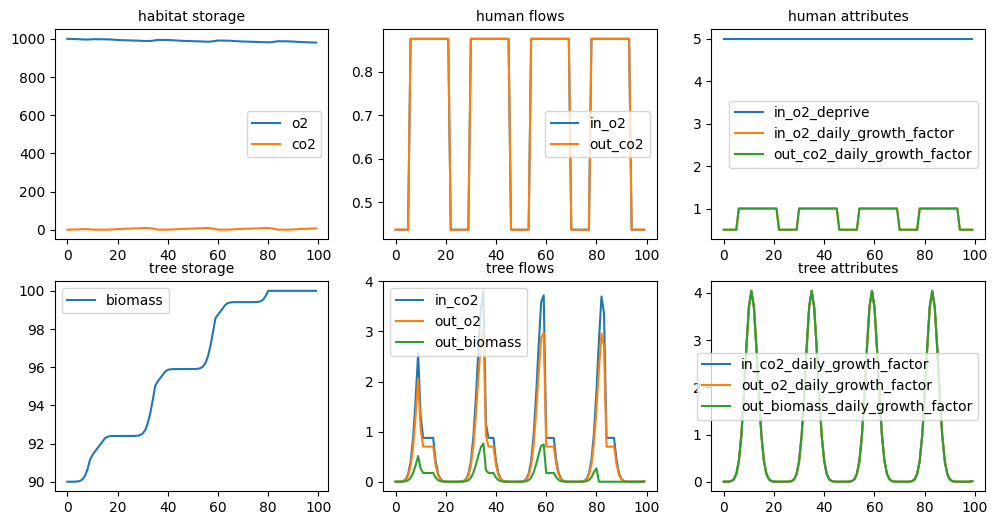
Now are humans are staying alive - great!
We can see that, after our tree hits 100 biomass (it’s maximum storage capacity), it stops accumulating. Let’s modify it so that, when it reaches maximum capacity, some of it is converted into fruit.
Add two new
flows: an inflow of biomass from the tree itself, and an outflow offruit(we’ll also add this as a currency, and add a basicfood_storageagent to store it).To these flows, we’ll add a new attribute
fruitingto theweightedlist. This will be a 0 most of the time, and 1 when we want to activate these flows.We’ll create a new subclass of BaseAgent called
TreeAgentin order to handle the custom logic of the ‘fruiting’ attribute:Following the convention of other SIMOC-ABM agents, we add “fruiting” to a class property,
default_attributes, and insert this into the attributes kwarg in our overloaded__init__function before forwarding it to the BaseAgent “init” function.In the
stepfunction, we’ll check if our internal biomass storage is full and, if so, set the “fruiting” attribute to 1. Remember that when overloading thestepfunction, you should add a register loop at the beginning. In this case, ignoring it won’t break anything, but it’s still good practice.
[9]:
class TreeAgent(BaseAgent):
    default_attributes = {'fruiting': 0}
    def __init__(self, *args, attributes={}, **kwargs):
        attributes = {**attributes, **self.default_attributes}
        super().__init__(*args, attributes=attributes, **kwargs)

    def step(self, dT=1):
        if not self.registered:
            self.register()
        if self.storage['biomass'] == self.capacity['biomass']:
            self.attributes['fruiting'] = 1
        else:
            self.attributes['fruiting'] = 0
        super().step(dT)

model = get_human_model()
model.add_currency('biomass', category='nutrients')
model.add_currency('fruit', category='food')
model.priorities = ['inhabitants', 'structures', 'plants']
food_storage = BaseAgent(model, 'food_storage', agent_class='structures', capacity={'fruit': 100})
tree = TreeAgent(model, 'tree', agent_class='plants',
                 capacity={'biomass': 100},
                 storage={'biomass': 90},
                 flows={'in': {'co2': {'value': .01,
                                       'connections': ['habitat'],
                                       'weighted': ['biomass'],
                                       'growth': {'daily': {'type': 'norm'}}},
                               'biomass': {'value': 10,
                                           'connections': ['tree'],
                                           'weighted': ['fruiting']}},
                        'out': {'o2': {'value': 0.008,
                                       'connections': ['habitat'],
                                       'weighted': ['biomass'],
                                       'requires': ['co2'],
                                       'growth': {'daily': {'type': 'norm'}}},
                                'biomass': {'value': 0.002,
                                            'connections': ['tree'],
                                            'weighted': ['biomass'],
                                            'requires': ['co2'],
                                            'growth': {'daily': {'type': 'norm'}}},
                                'fruit': {'value': 10,
                                          'connections': ['food_storage'],
                                          'weighted': ['fruiting']}}})
model.add_agent('food_storage', food_storage)
model.add_agent('tree', tree)
records = run_and_plot(model)
